The Most Comfortable Bed Isn’t the One To Sleep In

“Bad habits are like a comfortable bed: easy to get into, but hard to get out of.”
~ Proverb
Have you ever told yourself you were getting up early, and then the alarm went off and you hit snooze? Of course you have. Every man reading this has. And in that half-awake minute, the mind gets creative. It will tell you a story so reasonable you’d swear it was true:
-
You’re tired.
-
You earned it.
-
Tomorrow’s a better day to start.
That’s the comfortable bed. And it isn’t just the one you sleep in. It’s anywhere a man settles in because it’s easy and it asks nothing of him:
-
The routine he let slide.
-
The story about why now isn’t the time.
-
Whatever’s easy to get into, but hard to get out of.
Our minds are wired to keep us in comfort. That’s their job, and they’ll defend that bed with everything they’ve got.
I’m up at four AM most mornings a week for CrossFit. I can’t tell you how many times I’ve been lying there, half awake, half asleep, while my mind builds its case for the snooze. The reasons get pretty crazy. You don’t even need to do this today. Just cancel. Nobody’s going to notice if you don’t show up.
Then a second voice comes in.
What are you doing? Get out of bed. You made a commitment. Go do it.
Both of those voices are mine. Only one of them speaks to the man I’m becoming.
It’s that same fight almost every time. And I take it seriously, because I don’t want my lower consciousness making my decisions. I know myself. If I keep living in comfort and handing the steering wheel to the part of me that wants the warm bed, I’ll stay there. No doubt about it. The disciplines go first, and then everything else starts sliding off track.
I know that because I’ve lived it. If I had a dollar for every time I stopped doing something I’d committed to because life got busy, I’d be a wealthy man. I’d have a great routine going. Then a heavy week would hit, and I’d skip two or three days. Just two or three. Before I knew it, two or three months had gone by, and I wasn’t doing any of the things I’d said I was going to do. No crisis. No big decision. Just a few comfortable mornings in a row.
How does that happen to a man who means it? Nobody wakes up and decides to quit. He just stays in bed one more morning, and then another.
Is that the man you want to be? The one who gets talked out of his own word by a pillow?
So let me ask you what I’d ask any man sitting across from me. Is there anything you’ve done every single day, without fail? And I’m not talking about wearing deodorant. Something you do for yourself, every day, no matter what the day looks like.
For most of us, the honest answer is no. That’s not a character flaw. It’s what happens when a promise stays open for negotiation. The minute a commitment to yourself is negotiable, the bed gets a vote, and at four thirty in the morning the bed makes the best argument in the room.
So, take away the vote! You don’t decide whether you do it. Like Nike, you just get up and do it. And the morning after you miss, because you will miss again, you don’t turn it into a verdict on who you are. You get up and do it again.
This week’s lesson: Every promise you leave open to negotiation, becomes the comfortable bed you can’t get out of.
They Made Me the Problem. I Let Them.

“Whoever can be trusted with very little can also be trusted with much.”
Luke 16:10 (NIV)
Tell me what your morning looks like, and I’ll tell you what your life looks like.
Most men give me the same answer. Snooze the alarm twice. Teeth, clothes, coffee, kiss your wife, then out the door. But there’s nothing in it that belongs to the man himself. Not even five minutes. Why is that? he’ll tell you it’s a time problem.
It isn’t. It’s a trust problem.
Somewhere along the way, he decided that a promise he makes to himself at six in the morning isn’t going to hold, so he quit making them.
Sooner or later, everything you haven’t dealt with gets called to the floor. A business will do it. So will a marriage. And when you get called to the floor, you don’t get to stand on what you told people you built. You stand on what’s under you. Your foundation.
Do you trust your own foundation? Do you trust that it will hold the weight of the crisis? What’s been on my mind this week is that trust: how it gets built, how it breaks, and how long I had it backwards.
When I was a young leader, I thought trust was something you handed off to a man at the first instinct. You’ve proven you can do the job? Great. You’re in charge of it. Good luck. And then I’d be off building the next big thing.
It took me years to see: Trust you hand over with no follow-up isn’t trust; it’s hope. What we need is the discipline to follow up and the patience to watch for specific signs before we hand a man the keys. Not because I expect him to fail. But because that’s how trust gets built, a little at a time. Trust through verification.
So, the founder starts doing that. He starts checking in with his team. He asks a few questions and doesn’t get the answers he wanted. And his gut starts tingling. I call it the spidey sense. He can’t tell you what’s wrong, but he’s sure something is. He will then do one of two things:
The right way: Go straight to the source with specificity. “I saw [this], and they made me feel like we’re off track. Can you sit down with me and help me understand what’s going on with [that]?”
The wrong way: Avoid the conflict with generality: “I need every report available on the company, and I need them done now.” No explanation, no specifics, and deadlines nobody can hit.
If he chooses the wrong way, he doesn’t build trust – he starts a war of egos. The man he put in charge of the job is asking now himself, what does he want from me? Why doesn’t he trust me? Both men dig in for a fight. All the energy that should be moving the company forward goes into proving who’s right, and that whole part of the business stops growing.
You build trust piece by piece, and you also destroy it piece by piece. There’s not one big betrayal, but little wedges, driven in by emotion. When a man feels unsafe, or feels small, he starts writing a story that proves he’s right, and then he recruits people who’ll agree with it. You see it in families too, when a parent gives one kid more than the other, and two siblings who never did a thing to each other end up rivals.
The story doesn’t validate reality. It validates how you feel about it, which becomes your reality.
So where in your life are you living the story instead of asking the specific question? And the harder one: do you trust yourself enough to ask for the truth?
A man who can’t keep a five-minute promise to himself is going to have a hard time trusting anybody else to keep theirs.
This week’s lesson: Trust isn’t something you hand a man. You build it, one kept promise at a time, starting with the ones you make to yourself.
Insurgent CEO Is Now on Spotify and Apple Podcasts!
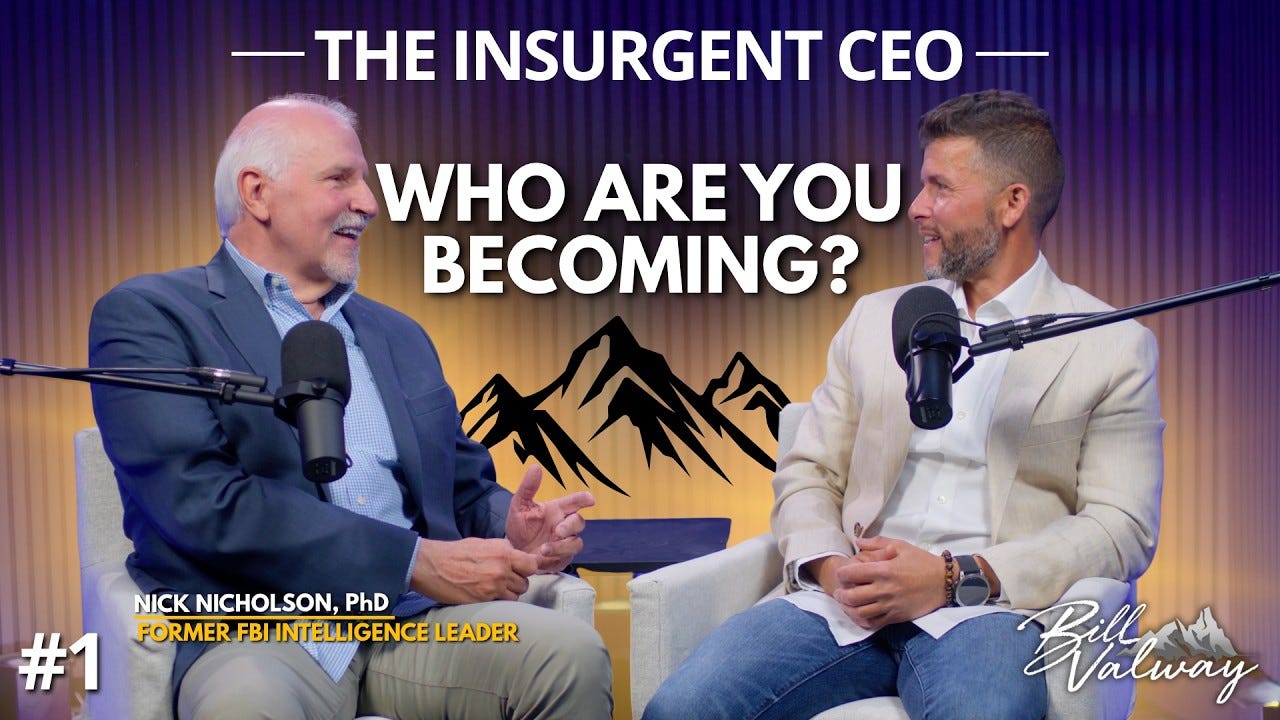
The video came out last week. Now the show is in the feeds.
Insurgent CEO is live on Spotify, Apple Podcasts, and here on Substack. Episode one is with Nick Nicholson, my mentor and a former FBI leader, on behavioral patterns, external validation, breaking generational patterns, faith, and fatherhood.
Build the man. Protect the legacy.
Follow the show wherever you listen, and the next episodes come to you automatically.
Keep climbing your summit.
Bill
Want to work with me on you? Book a free discovery call at billvalway.com
Implosion is a Journey of One-Thousand Steps

“It is in our darkest moment that we must focus to see the light.” – Aristotle Onassis
Every man has a season where the only thing he can see is what he is losing. That is not weakness and it is not a lack of faith. It is what being in the darkness does to a man’s eyes.
I have been in that season this year. It ended this week.
Here is the thing about the dark. There is always something good in it, and you get to choose which part of it you look at. When I submit to the darkness, I am a victim. When I focus on gratitude and on what I still have, and on the good coming that I cannot see yet, I am a man moving through the tunnel. That choice is not one decision and done, but one made almost every morning for years. The mornings I chose wrong, I knew it by noon.
When it all came to the end last week, I could have focused on the financial loss. Here is what I chose to focus on instead: I have full custody of my children.
Less than one in ten men who go through what I went through end up there. I paid for it. If a man’s job is to build and to protect, then I can stand at the end of the hardest year of my adult life and know I did the job. I protected my children. I protected their innocence. I protected what they are going to inherit from me.
And I know I protected their innocence, because I have proof, and the proof came in the middle of the worst of it. I was sitting in a legal negotiation that ran seven and a half hours. Somewhere in the middle of it, both of my kids texted me about something that had nothing to do with anything, some small thing that mattered to them that day.
My first reaction was frustration. I am in here fighting for my life and you are asking me about this?
I told someone I trusted about it afterward and they stopped me and said No, that is an example of your leadership. If you had been showing them how awful this was, how hard, how frightening, they would be worried about you right now. They would be reaching out to comfort you. They are children, and they do not feel any need to do that, because you carried the weight without setting it down on top of them.
I sat with that for a while.
Men, hear the whole thing. I did not get to that moment because I am a good man who did the right thing for twenty years. I got there because I lived the other way first, for a long time, in a thousand small increments that nobody could see, including me. The version of me who was handed that custody agreement is a different man than the one who started this. He got built one small decision at a time, in exactly the same way the other one got built.
That is the part I want you to take. The man who comes apart and the man who holds are not made by their big moments. They are both made by the small ones, going one direction or the other, for years, while nobody is watching and nothing appears to be happening.
This week’s lesson: You are only going to be the man you want to be by building it one decision at a time.
Episode 1 Is Live
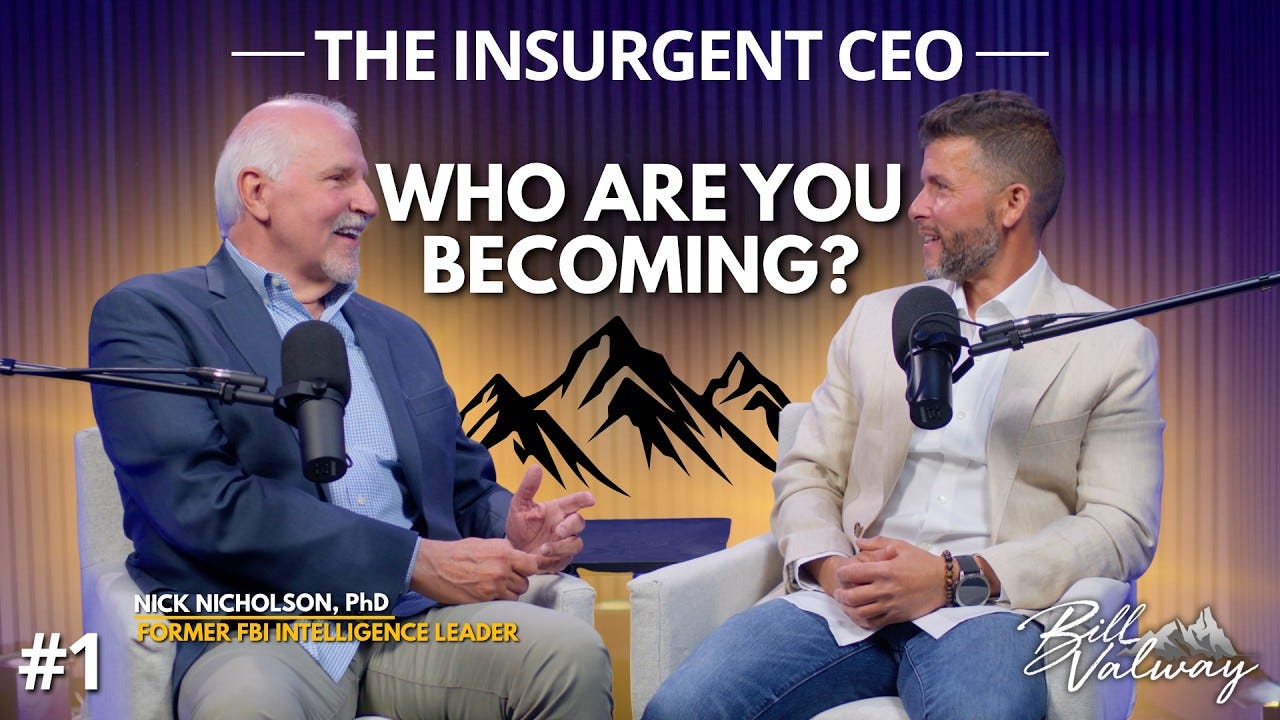
In my first ever episode of Insurgent CEO, I sat down with Nick Nicholson: my mentor, my friend, and a man whose career ran through the FBI, the Department of Energy, national security, executive protection, and threat assessment.
We talked about what actually builds a man. Why luck is preparation meeting opportunity. How your natural behavioral style shapes the way you lead, and what the DISC assessment shows you about the weaknesses you would rather not name. What a significant emotional event does to the way you show up afterward. My own long run on external validation, which is a road I know well. Why men need other men they can be honest with. The generational patterns you inherited and your responsibility to break them.
Gratitude, faith, fatherhood, and the heart attack that gave Nick the clearest view he has ever had of what matters.
Build the man. Protect the legacy. That is the whole project, and this conversation is the opening argument.
Watch it here:
If you are an entrepreneur, a leader, a husband, a father, or a man who knows there is another level available to you, this one is for you. When you are ready to look honestly at where you are and where you are going, book a discovery call at billvalway.com.
Keep climbing your summit.
Bill
How Four Words Broke a Successful Man

“The crucible for silver and the furnace for gold, but the LORD tests the heart.”
Proverbs 17:3
Have you ever thought about how you’d respond to a crisis? Some men are waiting on that moment when the real thing happens and they finally find out what they’re made of. I understand why that’s attractive. It means today doesn’t count.
It doesn’t work that way. Heat doesn’t put anything into the metal. Instead, it brings up whatever qualities, strong or weak, was already in there.
One time, I had a car come across the center line at me. I didn’t decide anything. My hands went before I knew they’d gone, the car zipped past before I understood I had almost been in a head-on collision. I said out loud that I was fine, and I was.
And yet my hands were still shaking a long time after that. My hands hadn’t gotten the message that I was safe. I watched them, noticing how long it took until they settled down. After all, I couldn’t show how scary that close-call was.
Here’s what I learned from that experience: Most of a man’s day goes into managing which version of himself is showing. Which one this room needs. Which one his team needs, his wife needs, his kids need, the man across the table needs. He doesn’t call it that. He calls it being professional, being steady, being fine. But it is work, it runs all day, and it bills him for every hour. And it’s quiet work, which is why he never counts it. He isn’t living the meeting, he’s monitoring it. Checking the room, checking the face, checking that the version showing is the version required. Ask a man what he did today and he’ll tell you about the project. He won’t mention the eleven hours of surveillance he ran on himself while he did it.
It holds for years. Then one day it stops holding, and it isn’t because somebody finally caught him. It’s because he ran out of the attention it takes to keep it up. Pressure is just the thing that drains that attention fastest. Not because pressure is cruel. Because pressure needs the whole man, right now, and there’s nothing left over to run the performance with.
Here’s what that looked like in a room this week.
I was leading a session, and I gave the man I was training one line to finish the sentence, I am… what? That was the entire instruction. Here’s the thing, I didn’t say write down what’s wrong with you. I didn’t say be honest about your flaws. I said, finish the sentence.
And yet this one man filled his page with everything he believes is wrong with him. He’s a successful man. Fifteen years in business, great customers, a good father, a caring man. And he sat there and wrote himself down into rubble.
I said nothing about it. We finished the exercise. Then I asked him, “Did I tell you to write something negative?”
He stopped. “No.”
“So where did that come from? You heard four words and you filled in the rest yourself. That’s how strong that muscle is. You’ve been working it a long time.”
He told me he was mind blown. He had no idea it was that loud in there.
He didn’t put a mask on for me in that room. He put one on years ago, for somebody else, and he’s maintained it so long that he answers a neutral question in its voice without noticing. That’s what these become. They stop being something you do and turn into the way you answer everything.
You’re going to find out what you’re made of eventually, one way or another. The only question is what you’ve been practicing while nobody was watching, because that’s what’s coming out.
This week’s lesson: Under pressure you become who you are.
Praise Will Own You Faster Than an Insult Will

“The moment you are disturbed by insult or pleased by praise, you are still a slave.”
Marcus Aurelius
Sometimes we think freedom means having enough money that nobody can tell you what to do. I believed that for a long time, but I was wrong about it. You can have the company, the title, the house, and still be run by whoever walked into the room and disrupted you, because the thing that owns a man is not his balance sheet. It’s what he resonates with.
Your body is a temple. It’s also a tuning fork. Strike it and it rings, and the tone tells you what’s actually in there. Most men spend their whole lives managing the sound instead of asking what’s making it.
I got struck twice this week, once from each direction.
The first one came from a courtroom I wasn’t standing in. Two and a half years I’ve been carrying a legal matter, and this week I expected it to end. Instead, the case got moved to administrative postponement until next April. Nine more months of waiting for closure on something that has already taken years off my life.
I could be upset about that. I could tell you the system is flawed and this isn’t fair and my life isn’t fair. I’m not going to do it. Everything is designed exactly the way it’s supposed to be, and every piece is falling into place exactly the way it was designed, and if I find that unacceptable it’s because I don’t understand the purpose of the plan yet. That isn’t my job to know. My job is to be a good steward of whatever comes down my way, learn from the hard parts, and appreciate the blessings.
The second strike came the same morning, and it was softer, and it got closer.
I took a man who works with me up in the plane for the first time. Clear morning, smooth air, about as good a day as you get for somebody’s first time in a small aircraft. Once we were up, I walked him through what my hands and feet were actually doing, because most people assume it’s all in the yoke. It isn’t. You roll the airplane into a bank and the nose wants to swing the other way, so you feed in rudder to hold it where it belongs. That’s a coordinated turn. There’s an instrument on the panel called the turn coordinator that tells you whether you’ve got it, and once you’ve flown enough you feel it in your seat before you ever look down at it.
Then I brought it in and set it down, and while we were rolling out he told me that landing was a lot smoother than he thought it was going to be.
He said it like a compliment, but it wasn’t one!
And I noticed something. I liked it!
I’ve been flying for years. Nothing about my ability changed between the runway and that sentence. But something in me went looking for that tone and I lit up when I got it.
Here’s what I know from where I sit today. Those are not two different problems. A man who gets moved by the courtroom and a man who gets moved by the compliment are the same man, and he is being fed from the outside because something on the inside went quiet.
That’s the part nobody tells you. Every one of us is getting fed somewhere. The business feeds you. The room full of people who think you’ve got it together feeds you. Being right feeds you. Being needed feeds you. And you don’t notice any of it while it’s working, because a thing that’s feeding you does not announce itself. It just keeps showing up at dinner.
So the question isn’t whether you’re being fed. You are. The question is what stopped. Whatever the outside is handing you right now, something else used to hand it to you, or was supposed to. Go find the thing that went silent, and put a rough year on it.
This week’s lesson: If a stranger’s opinion can move you, the opinion isn’t strong. You’re empty, and you’ll take a meal from anywhere.
How The Habit You Just Quit Is Still Getting Paid For

“Not everything that is faced can be changed, but nothing can be changed until it is faced.”
James Baldwin
Most men think the hard part is stopping. It isn’t. Stopping is loud, it has a date on it, and people notice. What comes after is quiet, and quiet is where men get lost. I know men who haven’t had a drink in years and are still the man who needed one. I’ve been that man.
Here’s how I’ve come to think about it.
If you’ve ever done work on a house, you know some walls hold the roof up and some don’t. They look the same from the hallway. Same paint, same trim, same light switch. The only way to find out which one you’re looking at is to take it out and see what moves.
A behavior works the same way. The drinking, the scrolling, the second job you didn’t need, the woman who isn’t your wife, the twelve hours a day you tell everybody is ambition. Every one of those is holding something up. You don’t know what until it’s gone. And most men never find out, because the day they take the wall out the roof doesn’t come down, so they decide the job’s finished and move on. Something else took the load. It always does. You just haven’t met it yet.
That’s the season I’m in. I picked up another coaching client this week, the cohort starts at the end of September, and I’m spending my days sitting across from men listening for the same thing every time.
Here’s what happened this week that drove that idea home for me.
The men I sat with are separated by decades. Different money, different problems, different parts of the country. And I’m hearing the same sentence out of all of them, dressed differently every time.
I can’t have that conversation.
I can’t put my money into that.
I can’t tell her the truth about this.
Not one of them is lazy. They’re performing at a level most men never reach, and every one of them is stopped at the same door, and thinks the door is the problem.
One of them runs a team. He’s got people under him who aren’t doing what they said they’d do, and he won’t say a word about it. Not because he’s soft. Because it feels risky to him. Somebody might push back. Somebody might turn around and tell him he’s wrong.
I asked where that comes from and it took four minutes. He grew up in a house where he was always doing something wrong. Not for anything he actually did. For existing in the wrong direction that day.
So he became a man who is careful. Who checks. Who’ll do the work of three men rather than have one conversation where somebody could tell him he got it wrong. And he calls that being a good leader.
Neither of those men has a behavior problem. They have behavior. One avoids a conversation, one avoids a risk, and if you took those behaviors away tomorrow and handed them nothing else, they’d be back inside a week in a different jacket.
That’s the part nobody tells you. Putting the thing down is the down payment. It is not the purchase. You can quit the drink, quit the app, quit the job, quit the woman, and keep the entire system that made you want it, and that system will go find something else to hold the roof up. It’ll pick something you haven’t learned to be ashamed of yet, and you’ll call it discipline.
You’re not being asked to become a man who doesn’t have the behavior. You’re being asked to become a man who knows what the behavior is doing for him.
This week’s lesson: stopping is the down payment, and most men spend the rest of their lives proud of the down payment.
You Have Been Calling It a Decision

“You fall to the level of your systems.” James Clear
Most men read their life as a list of decisions. The business you started. The one you talked about for six years and never started. The relationship you stayed in eighteen months past the end of it. You line all of it up, you call it a life, and you call every one of those a decision you made.
Go back and look again.
There’s a well underneath every man, and everything he draws up in a day comes out of it. And a man will stand there arguing about the bucket. Whether he should have moved sooner. Whether it was the timing, or the market, or her. He’ll do that for twenty years and never once look down the well. The bucket isn’t the problem. The bucket brings up whatever is already in there.
Clear is talking about habits when he says that. I’m talking about what sits underneath the habits.
There’s a sentence down there, and it’s been making your decisions for a long time. Mine says you’re never going to be good enough. That’s it. That’s the whole program. Another man’s says when it gets hard, run. Those are not the same sentence and they never will be, because yours was built out of your self image and it belongs to you alone.
It was written early, too. Most of what a man tells himself, he started telling himself before he was fifteen years old, with a brain that couldn’t make an adult connection yet and was making connections anyway. Then he spent thirty years collecting evidence for it, because that’s what we do. We go hunting for proof of the story we already have.
You’ll know you’ve found yours when you can lay it over the last twenty years of your life and watch it fit.
Here’s why it’s hard to catch. It never shows up sounding like a sentence. It shows up sounding reasonable.
You’ve felt this and you didn’t call it anything. You’ve felt it standing in your kitchen deciding whether to go to the gym. Everything in you says you don’t need to go tonight. You go anyway, you push, and you walk out better than when you walked in. So why was it hard, when you already knew how it ends? Because something in you ran an assessment on the spot and reported back that we’re fine right here, we’re comfortable, we don’t need to move.
Same mechanism, bigger stakes. Don’t leave the job and start the thing. Don’t have the conversation with your son when you already know something’s going on, because it isn’t directly in your face yet. I can’t do that right now. The kids are still in school.
It’s always a story, and underneath the story is a man who isn’t certain how it would go and would rather not spend himself on something that might not work. That isn’t laziness. It’s comfortable, and it will keep a man in a meager life for forty years.
The ego sitting on top of it is the same thing wearing a face. Look at what I built. Look at where I’ve been. Look at what I know. All of it pointing you away from the one thing a man is certain would end him if you saw it. And he isn’t only running the room with it. He’s running himself with it, which is how a man goes a whole life and never lands on the thing.
Mine still talks. It’s quieter than it was, and here’s what changed. I stopped reading it as the truth about me and started reading it as a gauge. When it gets louder, that’s not my marriage and it’s not my business. That’s me telling myself I’ve drifted off the work.
This week’s lesson: the decision you’re agonizing over isn’t the thing that needs your attention. The sentence underneath it is.
The Twenty Steps Costing Him the Whole Day

“If there is no struggle, there is no progress.” Frederick Douglass
A man will agonize over the big decisions and never once look at the small piece of ground he covers every morning without thinking about it. Twenty steps from the door of the house to the door of the car. Nothing happens out there. Nobody’s watching. And for a lot of men, that walk is where the whole day already got decided.
Here’s the season I’m in right now. I’m writing this book a chapter at a time, in real time, which means every week I go back into years I had filed away as handled and look at them again with grown eyes. And I’m still sitting down with my mentor the way I have every week for years, because I am not exempt from one word of this. What I’m about to tell you about myself, I did not see on my own.
Here’s what happened this week that drove that idea home for me.
A man I’ve been working with told me about his mornings. He pulls the front door shut behind him, and the second he hears it latch, the narration starts. Today’s going to be awful. It’s going to be hard. You’re going to screw it up. Twenty steps of that, every day, before he’s turned the key.
I asked him how it makes him feel. He said awful. I said no, how do you actually feel.
He stopped. Tight, he said. Heavy. Frustrated. Empty.
Is that how you want to start your day?
Of course not, he said. But it’s automatic.
It is automatic. That’s not a character flaw, it’s a habit, and it got built the same way the good ones get built. A thought runs, then it runs again, and the brain starts reaching for it the way it reaches for anything it’s practiced. Here’s the part men hate hearing. He’s getting something out of it. It isn’t good for him and he’s still getting something. Nobody keeps a pattern alive for years that pays him nothing.
I know that walk of his, except mine was a shower.
There was a stretch of my life where everything around me was chaos, and one morning I got in the shower and my mind put a scene in front of me involving my partner at the time. I didn’t think it. I felt it, all the way through my body, like it was happening. Then it happened again. Inside of two weeks I would reach for the shampoo bottle and I was gone, standing in something that never took place, feeling every bit of it as though it had.
That’s what I brought to my mentor, because I was not getting out of it by myself. And what I finally understood is that I could not think my way out. The thinking was the thing that was running.
So the next time it started, I turned the water to cold.
That’s the whole move. I couldn’t change my mind, so I changed my body.
Men, you cannot reason with a program while you’re standing inside it. You lose that argument every time, because the thing making the argument is the thing you’re arguing with. What breaks it is physical. Cold water. Twenty push-ups. On your knees in the hallway. Something immediate and inconvenient enough to interrupt a road you were already halfway down.
Then go find the road. Where are your twenty steps? What’s the stretch of your day that nobody sees, where the same sentence gets said to you by you, and you’ve heard it so many times you filed it under the truth?
This week’s lesson: the thought isn’t the problem. The route is. You’ve driven it so long you forgot you picked it.